

VO2Max, first defined in the 1920s to assess aerobic capacity, has only recently been reframed as a critical biomarker in ageing research. Today, it is one of the strongest indicators of healthspan – directly linked to mitochondrial efficiency, cardiorespiratory fitness, and all-cause mortality.
Peter Attia, author of Outlive, argues that if all biomarkers were rank-ordered by their ability to predict lifespan, VO2Max would sit at the very top. In this article, we explore what VO2Max reveals about your internal systems, and how to measure and improve it.
What is VO2Max?
VO2Max is the maximum volume of oxygen your lungs can inhale, and the heart can pump for the muscles to utilise during an intense workout. When you exercise, three systems work in tandem: the lungs, the heart, and the muscles. The lungs transport oxygen rich blood to the heart, which supplies it to the muscles that are involved during the workout. This oxygen rich blood is then utilised to drive energy production in the form of adenosine triphosphate (ATP) – within the mitochondria. During strenuous activity, the muscles work harder and utilise more oxygen to sustain ATP production.
When oxygen consumption plateaus despite increasing intensity, you have reached your VO2 peak. It is typically measured in either litres of oxygen per minute (L/min), or millilitres per kilogram of body weight per minute (ml/kg/min).
Factors that influence VO2Max
VO2Max is shaped by a mix of fixed traits and adaptive responses. Some you’re born with. Others, you build. Together, they define how efficiently your body uses oxygen when pushed to its limit.
Genetics: Even with consistent training, how much your VO2Max improves is partly pre-written. At least 97 genes are linked to VO2Max adaptation. Some people see rapid gains. Others improve slowly, but everyone improves with effort.
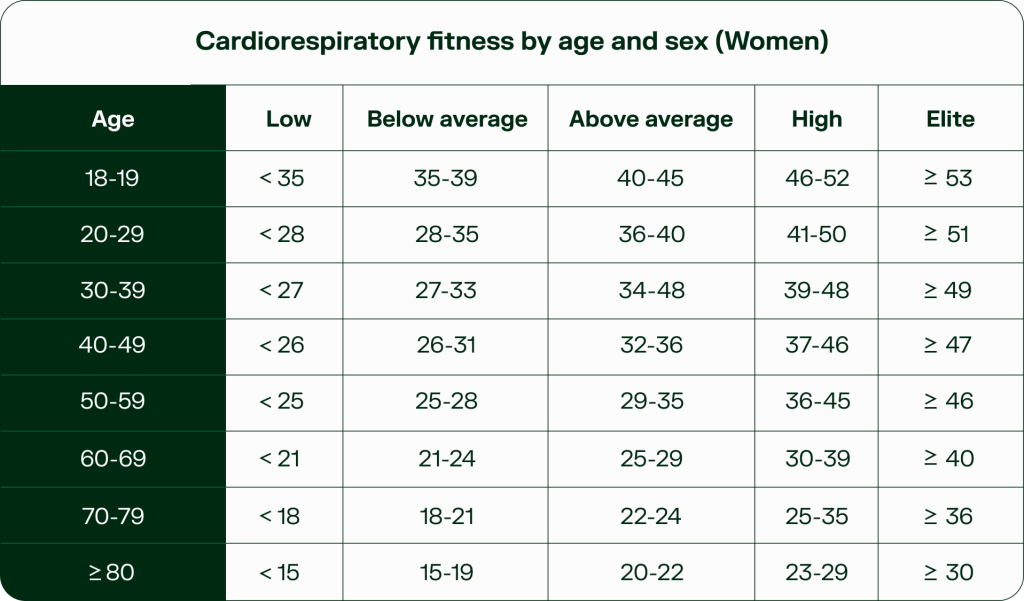
Age: Aerobic capacity declines with age. After 25, VO2Max typically drops about 10 percent per decade, and the rate accelerates past 50. This reflects a broader slowdown in cardiovascular and muscular function. Regular training does not stop the decline, but slows it down.
Body composition: High body mass index (BMI), especially if driven by fat rather than muscle, is associated with lower VO2Max. The body has to work harder to deliver oxygen efficiently.
Sex: Men generally record higher VO2Max values than women. This is due to physiological differences – larger hearts, more haemoglobin, greater muscle mass. These are baseline differences, not absolute limits. With training, women close the gap.

VO2Max: A systems biology marker for healthspan
VO2Max reflects how well your core biological systems perform when the body is pushed. Heart, lungs, blood, and muscle cells operate as a network, responding in real time to stress. That network determines endurance.
Cardiac output: How much blood your heart pumps per minute is a direct readout of cardiovascular performance. The higher the output, the more oxygen and nutrients reach working tissues when they need it most.
Pulmonary function: Lungs take in oxygen and exchange it with carbon dioxide; oxygen is transferred into the blood and delivered to the muscles via the heart.
Haemoglobin and oxygen carrying capacity: Haemoglobin is the carrier. It binds oxygen inside red blood cells. The more you have, and the better it functions – the more oxygen reaches your muscles under load.
Mitochondrial function in muscle cells: This is where oxygen becomes energy. Mitochondria inside muscle cells convert oxygen into ATP, the molecule that powers movement. Their number and efficiency set the ceiling for endurance.
Cognitive benefit: VO2Max isn’t only a marker of physical resilience. Higher scores are linked to better brain performance – likely driven by improved blood flow, higher neuroplasticity, and elevated BDNF (brain derived neurotrophic factor), a key molecule for learning and memory.
How can you measure VO2Max?
There are several ways to assess VO2Max – ranging from advanced laboratory testing to indirect estimates using wearables or simple field protocols.
Wearables: Smartwatches use a mix of onboard sensors: accelerometers, gyroscopes, photoplethysmography, and pulse oximeters, to estimate VO2Max. These sensors track heart rate, movement patterns, and oxygen saturation during activity. Algorithms based on real time exertion are generally more accurate than those relying on resting data. While not diagnostic, wearables are useful for observing trends over time, particularly when used consistently under similar conditions.
1.5 mile run test: This field test estimates VO2Max based on how quickly you can complete a 1.5-mile run.
Formula: VO2Max (ml/kg/min) = 88.02 + (3.716 × gender) − (0.0753 × weight in pounds) − (2.767 × time in minutes)
Gender = 1 for males, 0 for females.
Cooper’s 12 minute run test: Another widely used field method, the Cooper test measures how far you can run (or walk) in 12 minutes. The distance is plugged into a formula to estimate aerobic capacity.
Formula: Estimated VO2Max (ml/kg/min) = (35.97 × distance in miles) − 11.29
Laboratory testing: The most accurate method is a graded exercise test (GXT) conducted in a clinical setting. You exercise on a treadmill or cycle ergometer while respiratory gases are continuously monitored. This test maps your true aerobic capacity by measuring the precise point at which oxygen uptake plateaus, even as effort increases.
How to improve VO2Max?
VO2Max is highly responsive to training, but not all exercise drives the same adaptations. What matters is intensity, duration, and consistency.
- High intensity interval training (HIIT) is one of the most effective strategies. Short bursts of aerobic effort, performed at near maximal intensity, followed by recovery periods, trigger improvements in both cardiac output and mitochondrial efficiency.
- Endurance training at moderate intensity also builds aerobic capacity, especially when sustained over time. Long, steady state sessions condition the heart, lungs, and muscles to use oxygen more efficiently.
- Even brief, repeated efforts, if structured well, can produce measurable gains. The key is progressive overload and recovery.
But training is only half the equation. Adaptation depends on recovery. Sleep, micronutrient availability, and rest cycles directly impact how well your cardiovascular and muscular systems respond to stress.
Whether through structured protocols, daily movement, or personalised tracking, optimising VO2Max may be one of the most impactful long term decisions you make for your health.