


Ambition needs a body that can keep pace.
You have goals, big ones. You want to build, create, and perform at a high level for a very long time. The thing is that, ambition will last as far as you are able to physically and mentally do things with clarity, and cognition. But that fade-away isn’t inevitable. We’re here to talk about how to prevent it.
For centuries, we’ve been obsessed with finding an external “fix” for this. Look at our oldest stories: emperors chasing immortality elixirs, explorers hunting for a fountain of youth, gods battling over a nectar of eternal life. We’ve always been looking for a magic pill.

What if the secret isn’t about adding something, but taking something away?
What if the most powerful protocol for renewal and resilience was already built into our bodies, just waiting for us to use it? This is the logic of fasting. Fasting is power in the form of restraint.
The two modes your body can live in

Your metabolism isn’t random. It runs on a rhythm: eat → build → pause → repair. Most of us never reach the second half anymore. When you’re fed, the priority is growth: digest, absorb, store, build. Insulin rises, cells take in energy, the body stays busy.
Useful, but incomplete.
When you stop eating, another program wakes up. The body starts using stored fat, inflammation cools, damaged cells are marked for recycling, energy systems rewire for efficiency, the brain clears.
That shift from growth mode to repair mode is the metabolic switch that determines whether your biology ages fast or ages well. Ageing is not just time passing – it is how long you stay trapped in growth mode without ever entering repair.
What happens when you fast
This is the fasting timeline. Strip away from the hype of fasting just for a bit. It’s a really misunderstood and misrepresented protocol. And because fasting advice comes from so many sources – from ancient traditions to modern diet fads – the ‘why’ behind it often gets confused.

You’re still living off your last meal. Blood sugar falls, insulin drops, the body starts hinting: switch to reserves soon. It begins draining glycogen – your stored sugar tank. This phase might be a bit tough considering your body is just adjusting, and you feel hungry at your regular time. Pass this phase, and the good times for your gut start.

Glycogen reserves get low, the fat-burning process ramps up, and fat gets converted to a mixture of free fatty acids (FFAs) that are released from your body’s fat stores (adipose tissue). The liver makes ketones, which the brain loves – they’re steadier, cleaner, and don’t spike and crash like glucose. In this phase, people feel the first real shift: no hunger panic, just a different kind of clarity.

The body is now running on fat and ketones. With the growth pathway “mTOR” downregulated, cells get the signal to stop dividing and start auditing. Cells enter quality control mode – tagging old, damaged and dysfunctional parts for removal.

Autophagy, the nirvana state of fasting, begins. Now the cells are very actively seeking out and recycling their own damaged components. Damaged proteins, malfunctioning mitochondria, and molecular junk are recycled into raw material. The body at this stage is not trying to survive a fast but is upgrading itself.
The body isn’t trying to survive the fast.
It’s using the fast to upgrade itself.
Why fasting extends healthspan
Fasting is one of the most powerful and well-studied paths to longevity. If fasting were only about fat loss, we would be talking about it differently. Here are the pathways that come into play during a fast.
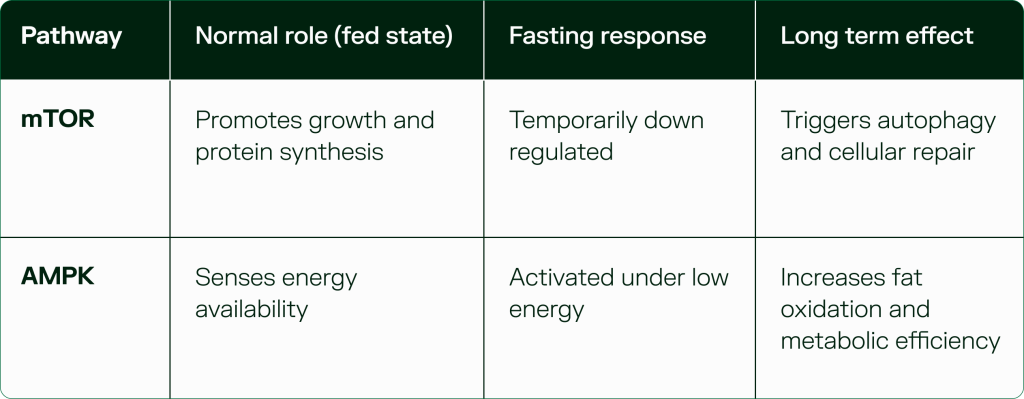
- mTOR (Mammalian Target of Rapamycin): In the fed state, mTOR is high, telling cells to grow and divide. When one fasts, mTOR quiets down. This silence is the signal for cells to stop growing and start repairing.
- AMPK (AMP-activated Protein Kinase): Think of AMPK as the body’s core energy sensor. When it senses energy is low (during a fast), it lights up. Activated AMPK is the “go” signal for burning fat, improving energy efficiency, and activating deep repair processes.
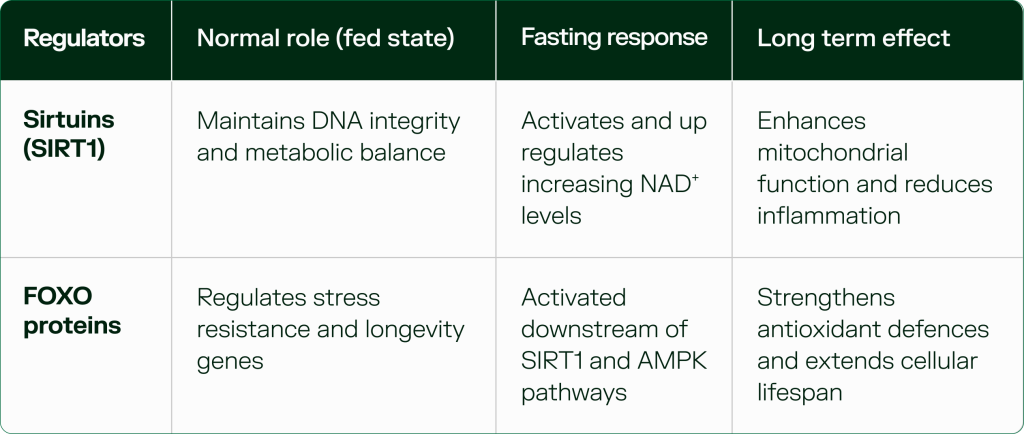
- Sirtuins (SIRT1): These are a family of proteins that act as “guardians of the genome.” Fasting activates sirtuins, which work to protect DNA, lower inflammation, and boost mitochondrial function – the “batteries” that power your cells.
- FOXO proteins: When mTOR is quiet and AMPK is active, these powerful proteins are unleashed. They move into the cell’s nucleus to turn on a suite of protective genes – genes associated with stress resistance, antioxidant defenses, and longevity.
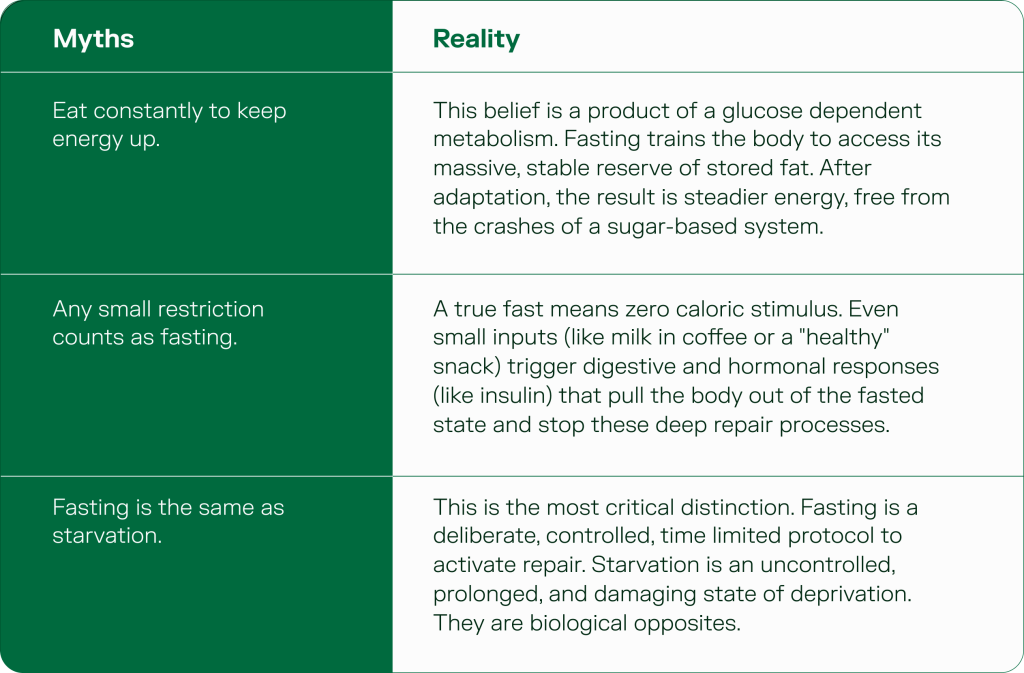
Myths vs. Reality
Fasting isn’t for everyone
This is a powerful stressor. And “hormesis” (what doesn’t kill you makes you stronger) only works if the dose is right.
You must hit pause and talk to your doctor before trying this if you:
- Are pregnant or breastfeeding
- Are underweight
- Are managing a condition like diabetes or severe reflux
- Take medications that must be taken with food

What to track during a fast

The “intuitive wisdom” our ancestors had is now complemented by modern data that shows us exactly what’s changing.
The feedback loop starts with what you feel, often quite quickly:
- A different kind of clarity that cuts through the mental fog.
- A more resilient gut that feels calmer and less reactive.
- A general improvement in your subjective quality of life and energy.
Your wearables will often be the first to tell the story, reflecting a body that is less stressed and more efficient:
- Higher HRV (Heart Rate Variability) score, a clear sign that your “rest and repair” (parasympathetic) nervous system is in charge.
- Lower Resting Heart Rate (RHR), as your heart doesn’t have to work as hard.
- Better, more consolidated sleep scores, as your body’s resources shift to deep restoration.
The biomarkers of metabolic health will begin to move, proving that you are fundamentally improving your metabolic flexibility:
- Improved fasting glucose and HbA1c, showing you have better long-term blood sugar control.
- Lower fasting insulin (and an improved HOMA-IR score), indicating your body is becoming more ‘insulin sensitive’ – a cornerstone of longevity.
- Lower waist-to-hip ratio, a powerful indicator that you are reducing the harmful visceral fat around your organs.
By reintroducing this deliberate pause, we’re not just activating autophagy or switching fuel sources. We are, quite simply, giving our bodies back the protocol they were always designed for.
The takeaway is simple. You don’t need a mythical elixir or a futuristic pill. You have a switch. You have a “repair” mode. Learning to use it is the single most powerful way to take control of your biology, clear the fog, and build the resilience your ambition demands.