
IBS has a treatment problem: almost anything can look as though it worked for three days.
Symptoms fluctuate. Meals change. Sleep changes. Stress changes. You stop milk on Monday, start a probiotic on Tuesday, eat out less on Wednesday and feel better by Friday.
The probiotic gets the credit.
Or the milk gets the blame.
That is how an IBS treatment plan can turn into a pile of conclusions that are impossible to test.
The useful distinction is between three things:
A trigger can provoke symptoms. A biological mechanism may help explain why those symptoms happen. A treatment has to show that changing something actually improves them.
Those categories overlap, but they are not interchangeable.
A food can trigger bloating without having caused IBS. Stress can worsen pain without making IBS imaginary. Someone can have a positive SIBO breath test without bacterial overgrowth explaining every symptom.
And that is probably the most important idea in IBS treatment.
Current research does not point to one mechanism shared by everyone with IBS. Altered bowel movement, visceral sensitivity, previous infection, immune activity, intestinal permeability, microbial changes, carbohydrate and bile-acid metabolism, and altered nervous-system processing can all be involved in different combinations.
So there is no single best IBS treatment.
The useful treatment is the one that matches the problem actually dominating your IBS.
What is the best treatment for IBS?
Current guidelines take a symptom-based approach.
Someone mainly struggling with constipation may need a very different treatment from someone whose main problem is urgent diarrhoea. Someone whose stools are reasonably controlled but who has persistent abdominal pain may need another approach again.
Rome V places diet, medicines directed at the dominant symptom and brain-gut behavioural therapies at different points in IBS management rather than treating one of them as the universal answer.
That sounds obvious.
The internet does almost the opposite.
It tends to ask:
What is the IBS food?
What is the IBS probiotic?
What is the IBS medicine?
The better question is:
What symptom or mechanism are we trying to change?
Which foods should you avoid with IBS?
There is no universal IBS blacklist.
That matters because once people start associating food with symptoms, the list of suspected foods can grow surprisingly quickly.
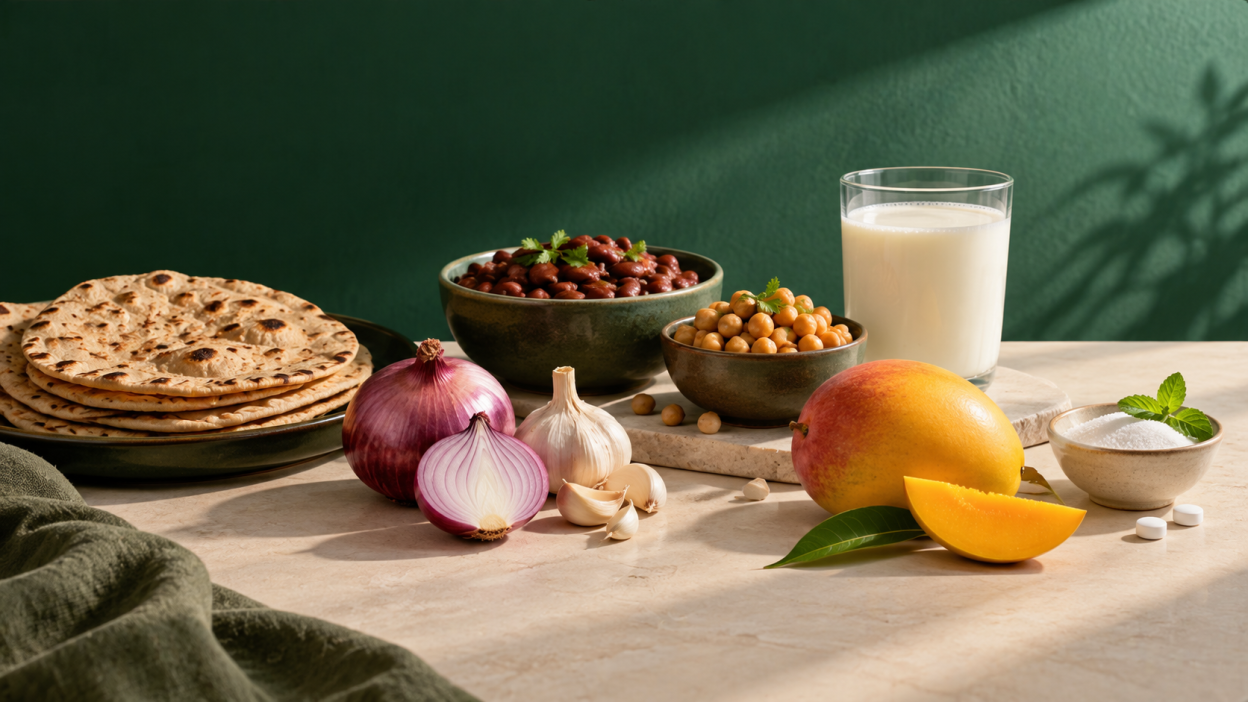
A painful evening follows rajma. Rajma goes.
Milk causes bloating once. Milk goes.
A roti seems suspicious. Wheat goes.
Soon someone is eating six “safe” foods and still has IBS.
Diet absolutely can influence IBS. But the goal is not to discover the longest possible list of foods your gut can survive without. Restrictive diets can affect diet quality, food-related quality of life and, in some people, create problematic food avoidance.
The aim is to identify which components, in which amounts, actually reproduce symptoms, and then preserve as varied a diet as possible.
That is where FODMAPs become useful.
What are FODMAPs?
FODMAP stands for fermentable oligosaccharides, disaccharides, monosaccharides and polyols.
The acronym is terrible. The idea is simpler.
These are short-chain carbohydrates that are poorly or incompletely absorbed in the small intestine in some circumstances.
That can do two things.
Some pull additional water into the intestine. Others reach gut microbes, which ferment them and produce gases and other metabolites.
The result can be more material and gas inside the bowel.
In someone whose intestine is particularly sensitive to stretching, that extra distension can translate into bloating, discomfort, pain, urgency or altered bowel movements.
Notice what this mechanism does not say.
FODMAPs are not inherently “bad foods”.
Many high-FODMAP foods are nutritious.
And eating a high-FODMAP food does not cause IBS.
The issue is whether a particular carbohydrate, portion and meal produces symptoms in a particular person.
What does a low-FODMAP diet actually involve?
The low-FODMAP diet has some of the strongest evidence among dietary interventions for IBS. But what is commonly called “the low-FODMAP diet” online is often only its first phase.
The proper strategy is restriction, followed by reintroduction, followed by personalisation.
The restriction phase is supposed to help establish whether FODMAP reduction changes symptoms. Foods are then systematically brought back to identify which groups and amounts are actually tolerated.
The intended end point is therefore not a permanently low-FODMAP diet.
That distinction is especially important because restrictive versions can reduce fibre and other nutrients and change the intestinal microbiome. Long-term restriction can also become difficult socially and practically.
And we do have Indian trial data.
A 2021 randomised trial in 101 Indian adults with diarrhoea-predominant IBS compared a low-FODMAP diet with traditional dietary advice. After four weeks, 62.7% of the low-FODMAP group met the study’s response definition, compared with 40.8% in the traditional-advice group.
But there is another number worth noticing.
Compliance with the low-FODMAP diet was 93% at four weeks and had fallen to 64% by week 16, even as foods were being reintroduced.
The diet can work.
Following it indefinitely is a different question.
A low-FODMAP diet in India does not look like a Western low-FODMAP diet
Indian diets create a practical problem for generic FODMAP lists.
Wheat, onion, garlic, pulses and legumes can all contribute substantial FODMAPs depending on the food and serving. One analysis of 269 traditional Indian recipes identified fructans and galacto-oligosaccharides as particularly important contributors, although the study estimated FODMAP content from recipe composition rather than directly chemically analysing every prepared food.
Regional eating patterns matter too.
The Indian consensus notes major differences in wheat versus rice consumption, vegetarianism and dairy intake across the country. Indian clinicians have also pointed out that adapting a low-FODMAP diet may be easier in some rice-dominant diets than in wheat-dominant diets.
A small Indian study gives an interesting illustration.
Researchers compared a lower-FODMAP meal containing rice, brinjal, corn and banana with a higher-FODMAP meal containing wheat, kidney bean, pulse and curd. Among 40 people with IBS, symptoms occurred much more often after the higher-FODMAP meal.
It was a small experimental study, not a licence to declare rajma, dal, curd or wheat forbidden. But it shows why Indian food patterns need to be studied directly rather than translated from a Western food chart.
Does milk cause IBS?
Milk gives us a useful example of the difference between malabsorption and symptoms.
Lactose is the carbohydrate in milk. People with insufficient lactase enzyme may not digest it completely, allowing more lactose to reach the colon.
That can produce gas, bloating and diarrhoea.
But lactose malabsorption is not the same thing as IBS.
In a northern Indian case-control study, abnormal lactose-test results were common in both the IBS group and healthy controls and were not significantly more frequent in the IBS group. Yet people with IBS developed symptoms after the lactose challenge more often.
That is a fascinating result.
Two people can process a carbohydrate similarly and experience the consequences differently.
So “milk makes my stomach hurt” can be completely real without proving that lactose malabsorption is the underlying cause of someone’s IBS.
It also means automatically removing every dairy product because someone has IBS makes little sense.
Can IBS start after food poisoning?
Yes.
This is called post-infectious IBS.
An intestinal infection can resolve while changes left behind in gut sensitivity, immune activity, barrier function, motility or the microbiome continue.
A 2024 systematic review covering 47 studies and 28,170 people found that about 14.5% developed IBS after acute gastroenteritis. People who had experienced gastroenteritis had substantially higher odds of later IBS than people who had not.
This is some of the clearest evidence that IBS can have a biological initiating event.
But that 14.5% is pooled international evidence, not an Indian prevalence estimate.
The Indian consensus specifically notes that India-specific post-infectious IBS research remains relatively limited. It also cautions that persistent symptoms after infection can occasionally overlap with post-infectious malabsorption syndromes seen in this region.
So six months of diarrhoea after a bad gastrointestinal infection should not automatically become:
“Food poisoning gave me IBS. Case closed.”
The timing is a clue, not the whole diagnostic work-up.
Is SIBO the root cause of IBS?
Sometimes SIBO and IBS overlap.
That does not make SIBO the universal explanation for IBS.
SIBO means small intestinal bacterial overgrowth, an abnormal increase or alteration of microbes in the small intestine. It can cause bloating, diarrhoea, abdominal discomfort and gas, so symptom overlap with IBS is obvious.
The difficulty is testing.
In one Chandigarh study, 175 people with IBS-D and 150 healthy controls underwent both lactulose and glucose breath testing.
With lactulose, 34.3% of the IBS group tested positive.
So did 30% of healthy controls.
With glucose, the figures became 6.2% and 0.66%.
Same broad question. Very different answer depending on the test.
That study is older and used Rome II IBS criteria, so it cannot settle the modern SIBO debate. But it illustrates the central problem extremely well.
A positive breath test is not automatically a clean measurement of “the cause”.
Current Rome V guidance therefore does not recommend routine SIBO breath testing as part of the initial IBS evaluation because of limitations in the tests and uncertainty about how the result should change management.
SIBO is real.
“SIBO explains everyone’s IBS” is not.
Does stress cause IBS?
Calling IBS “stress” is inaccurate.
Pretending stress cannot affect the bowel is inaccurate too.
The nervous system and intestine continuously exchange information. Stress can alter autonomic signalling, gut movement, attention to internal sensations and how pain signals are processed.
That makes stress a modifier of IBS in many people, not proof that the disease is psychological.
The distinction matters because it also explains why psychological treatments can improve gastrointestinal symptoms.
Why would CBT or hypnotherapy help a bowel problem?
Because they are not being used to convince someone that the pain is imaginary.
They are trying to change parts of the brain-gut system involved in symptom generation and amplification.
A 2024 systematic review and network meta-analysis included 42 randomised trials and 5,220 participants. Several brain-gut behavioural treatments, including forms of cognitive behavioural therapy and gut-directed hypnotherapy, improved abdominal pain compared with control approaches.
The evidence was not perfect. No included trial was judged low-risk across every bias domain.
That puts brain-gut behavioural therapy in an unusual but important position.
The biological model of IBS is actually the reason psychological treatment can make sense.
The gut influences the nervous system.
The nervous system influences the gut.
Treating one side of that loop does not make the other side fictional.
Does isabgol help IBS?
The unglamorous answer is that soluble fibre has better evidence than many trendier gut-health products.
Psyllium, also called ispaghula or isabgol, is a soluble fibre. It absorbs water and forms a gel-like material in the bowel.
Rome V cites evidence that soluble fibre such as psyllium can improve IBS symptoms, while insoluble bran has not shown the same benefit.
More fibre is therefore not automatically better.
The type of fibre matters.
And increasing fibre very quickly can itself worsen gas and bloating in some people, which is one reason fibre changes are usually introduced gradually rather than by turning breakfast into a fibre endurance event.
Do probiotics help IBS?
Maybe.
That sounds annoyingly non-committal because the evidence genuinely is.
“Probiotics” describes an enormous category of different organisms, strains, doses and combinations. Studying one probiotic does not prove that the bottle next to it on a pharmacy shelf has the same effect.
A 2026 systematic review included 40 randomised trials. Conventional meta-analysis found improvement in IBS symptom-severity scores, but the authors rated the overall evidence low certainty because results were inconsistent. Their additional trial-sequential analysis found that the accumulated evidence was still insufficient to make the result definitive.
Rome V reaches a similarly cautious position and notes that some people report more bloating with probiotics.
So the useful conclusion is not:
“Probiotics work.”
Or:
“Probiotics are useless.”
It is:
Some preparations may help some people, but “take a probiotic” is too imprecise to be a serious treatment plan.
Can exercise help IBS?
Probably, modestly.
A 2026 systematic review and meta-analysis included 10 studies and 437 people with IBS. Structured exercise interventions improved IBS symptom-severity scores compared with control groups.
They did not clearly improve quality-of-life or anxiety measures, and the researchers found no evidence-based standard prescription for the type, intensity or duration of exercise specifically for IBS.
So movement belongs in the conversation.
There is not enough evidence to turn one particular workout routine into an IBS protocol.
What about sleep?
People with IBS frequently report poor sleep and fatigue, and symptom severity tends to track with worse sleep.
A 2025 systematic review found a strong association between gastrointestinal symptom burden and sleep disturbance in IBS and IBD. But association cannot tell us which direction the relationship runs.
Poor sleep may aggravate gastrointestinal symptoms.
Severe gastrointestinal symptoms may disrupt sleep.
Both may happen simultaneously.
Sleep therefore matters.
The evidence does not yet justify telling someone that fixing sleep will cure IBS.
Which medicines are used for IBS?
There is no single “IBS tablet”.
Medicines are usually selected according to the symptom being treated. Availability also varies between India and other countries, and some drugs have important contraindications, so this table is a map of the treatment landscape, not a prescription.
| Main problem | Treatments a clinician may consider | What to understand |
| Constipation | Osmotic laxatives such as polyethylene glycol; prescription agents including linaclotide, lubiprostone, plecanatide or other locally available therapies | A treatment can improve stool frequency without fixing pain. In a trial cited by Rome V, polyethylene glycol improved frequency, consistency and straining but not abdominal pain or bloating. |
| Diarrhoea and urgency | Antidiarrhoeal treatment such as loperamide; selected IBS-D therapies such as rifaximin; other agents depending on country and clinical context | Loperamide is mainly useful for slowing stool transit and controlling frequency or urgency. Treatment for diarrhoea is not automatically treatment for pain. |
| Possible bile-acid diarrhoea | Bile-acid sequestrants in appropriately selected patients | Bile-acid diarrhoea can mimic IBS-D. Treatment makes more sense when that mechanism is actually suspected rather than given to every person with loose stools. |
| Pain or cramping | Antispasmodics, peppermint oil and, in selected patients, gut-brain neuromodulators such as low-dose tricyclic antidepressants | These treatments target smooth-muscle contraction or pain processing rather than simply changing stool consistency. |
| Persistent symptoms despite first approaches | Brain-gut behavioural treatment, dietary review, medication reassessment or multidisciplinary management | This is often more useful than simply adding another supplement or elimination diet. |
The Indian consensus includes a wider range of IBS medicines used in Indian and Asian practice than some Western guidelines do. That is a useful reminder that a treatment recommendation cannot always be imported directly from an American medication list.
So how do you work out what is actually helping?
IBS makes uncontrolled experimentation very tempting.
The more useful approach is almost boringly scientific.
Decide what you are trying to change first. Stool frequency? Stool form? Pain? Bloating? Urgency?
Change one meaningful variable.
Give it enough time to observe a pattern.
Then reassess.
If a temporary food restriction works, reintroduce foods and find the minimum restriction necessary. If a treatment changes constipation but not pain, do not call the entire treatment a failure. If something does nothing, stop giving it credit simply because it sounds biologically sophisticated.
The goal is not to collect interventions. It is to reduce uncertainty.
That is particularly important in a condition in which the symptoms themselves naturally fluctuate.
Can IBS be cured permanently?
There is currently no treatment that can guarantee a permanent cure for IBS.
That answer is less pessimistic than it sounds.
IBS symptoms can improve substantially. Some people experience long periods with few or no troublesome symptoms. Treatment can become much more precise once the dominant symptom and likely contributors are understood.
But “how to cure IBS permanently” is the wrong promise for current medicine.
A better target is:
fewer symptoms, fewer unpredictable flares, less food restriction, better bowel function and less of your life organised around your gut.
That is a meaningful outcome even when no one can point to one thing and declare IBS permanently erased.
FAQs: IBS Treatment
How do you get rid of IBS in one day?
You cannot, though you can usually shorten a bad day. During a flare – smaller, plainer, lower-fat meals for a few days, keeping fluids up, and using whatever your doctor has already prescribed for that particular symptom. What tends to prolong things is the panic response: cutting four foods at once, starting two new supplements, and losing any ability to tell what helped.
What is the best treatment for IBS?
There is no single best treatment for everyone with IBS.
The useful starting point is identifying what you are trying to improve: pain, bloating, constipation, diarrhoea, urgency or another symptom. Different approaches can improve different parts of IBS without necessarily changing the entire condition.
What foods should I avoid with IBS?
There is no universal list, which is why the ones circulating online are so unhelpful. The groups most often involved are fermentable carbohydrates found in wheat, onion, garlic and pulses, along with lactose, very large or oily meals, and strong coffee on an empty stomach. The same food can be fine on one day and difficult on another, because total load matters as much as any single item. The reliable way to find your own list is a structured low-FODMAP trial with proper reintroduction, not permanent removal on suspicion.
What is a low-FODMAP diet?
A low-FODMAP diet temporarily reduces fermentable carbohydrates that can increase water and gas inside the bowel.
It is normally used in three stages: reduction, reintroduction and personalisation. The aim is to identify which FODMAPs actually cause symptoms and eventually return as much variety to the diet as possible.
Is a low-FODMAP diet the same as a gluten-free diet?
No.
Wheat is relevant to a low-FODMAP diet largely because it contains fructans. Gluten is a protein.
Someone can therefore find that wheat triggers symptoms during a FODMAP experiment without that automatically meaning they have coeliac disease or that gluten itself is responsible.
Can rajma, dal or chana trigger IBS?
They can trigger symptoms in some people because many pulses and legumes contain GOS, a type of FODMAP.
That does not mean everyone with IBS should avoid pulses. Portion size, the type eaten, the rest of the meal and individual tolerance all matter. This is especially important for vegetarians who rely on pulses as a major source of protein.
Why can I eat something one day and react to it the next?
IBS tolerance is not always a simple yes-or-no property of a food.
The amount can matter. Several fermentable foods can add up across the same meal. Your bowel may also be more sensitive during a flare than during a settled period.
One bad reaction is therefore less informative than a pattern that can be reproduced.
Is SIBO the same as IBS?
No.
They can produce similar symptoms and can coexist, but they are different conditions. SIBO may contribute to symptoms in a subset of people with IBS, but current evidence does not support treating it as the universal cause of IBS.
Breath-test results also need careful interpretation because different tests can produce very different answers.
Do probiotics help IBS?
Not reliably, on the evidence available. American guidelines suggest against probiotics for overall IBS symptoms. The 2023 Indian consensus is more open, saying they may be helpful but that more studies are needed, and that statement drew the lowest agreement of any in the entire document. The core problem is that trials use different organisms, doses and outcome measures, so a benefit shown for one specific strain tells you nothing about a different product on a pharmacy shelf. If you do try one, give it a defined period, change nothing else at the same time, and stop if nothing shifts.
Does stress make IBS worse?
Stress can change how loud the symptoms are. Stress affects how the bowel moves and how pain signals are processed, and unpredictable gut symptoms generate their own anxiety in return, particularly the anticipatory kind where the worry is about where the toilets will be rather than about the pain itself. Someone who has cancelled two trips because of their gut has a reasonable fear, not a psychological disorder. Saying stress is a trigger is accurate. Saying stress is the cause is not.
How do I know whether something is actually helping my IBS?
Decide what you want to improve before making the change.
Where possible, avoid starting several interventions at once. Then judge the thing you actually changed against the symptom you were trying to change.
An intervention does not have to improve every IBS symptom to be useful.
Can IBS be cured permanently?
No. IBS is managed rather than cured, and no diet, supplement or medicine currently available removes it for good. What is realistic is long stretches where symptoms are mild or absent, reached by stacking several modest improvements rather than finding one decisive fix. Flares returning after a stressful month, a course of antibiotics or a bad meal is the normal shape of the condition rather than proof that treatment failed.