
Two people eat the same meal. One is fine. The other spends the evening bloated. The same person eats a small portion comfortably on Tuesday and struggles with a larger one on Friday.
FODMAPs explain part of that gap. They are a group of carbohydrates that pull water into the intestine or get fermented by gut microbes into gas. In a gut that is unusually sensitive to being stretched, that extra volume can register as pain, pressure, bloating or urgency.
The diet built around them asks four questions in sequence. Do symptoms improve when FODMAP intake falls? If so, which FODMAPs are responsible? How much of them can you tolerate? And once you know that, how much food can come back?
Only the first question involves restriction. The other three are about getting food back on your plate.
What FODMAP means
FODMAP stands for fermentable oligosaccharides, disaccharides, monosaccharides and polyols.
Some are not digestible by human enzymes at all. Others are only partly absorbed in the small intestine. Either way, more carbohydrate stays inside the gut than the body intended. Some of it draws water in. Some travels down to the colon, where bacteria ferment it and produce gas.
What is easy to miss is that different FODMAPs do physically different things. Kathryn Murray and colleagues at Nottingham gave 16 healthy volunteers drinks containing glucose, fructose or inulin and scanned them hourly by MRI. Fructose distended the small bowel with water. Inulin, a fructan, barely touched small bowel water but filled the colon with gas.
“FODMAP” describes a category, not a single substance, and the category behaves in at least two distinct ways inside your body.
None of this makes FODMAPs harmful. The foods that contain them are fruit, vegetables, whole grains, legumes and dairy. The question is never whether a food is good. It is how much of a particular carbohydrate a particular gut can take before it complains.
Which foods contain FODMAPs
They turn up in foods that otherwise have nothing in common.
| FODMAP group | What it is | Familiar sources |
| Fructans | Chains of fructose molecules | Wheat, onion, garlic |
| GOS | Galacto-oligosaccharides | Rajma, chana and most pulses |
| Lactose | The sugar in milk | Milk and some dairy products |
| Excess fructose | Fructose present beyond what glucose can carry across the gut wall | Certain fruits, honey |
| Polyols | Sugar alcohols such as sorbitol and mannitol | Certain fruits, vegetables, sugar-free sweeteners |
Portion size sits underneath all of it. A small serving may fall below your threshold where a large one does not. And meals are combinations, which is where reading your own symptoms gets genuinely hard.
What this looks like on an Indian plate
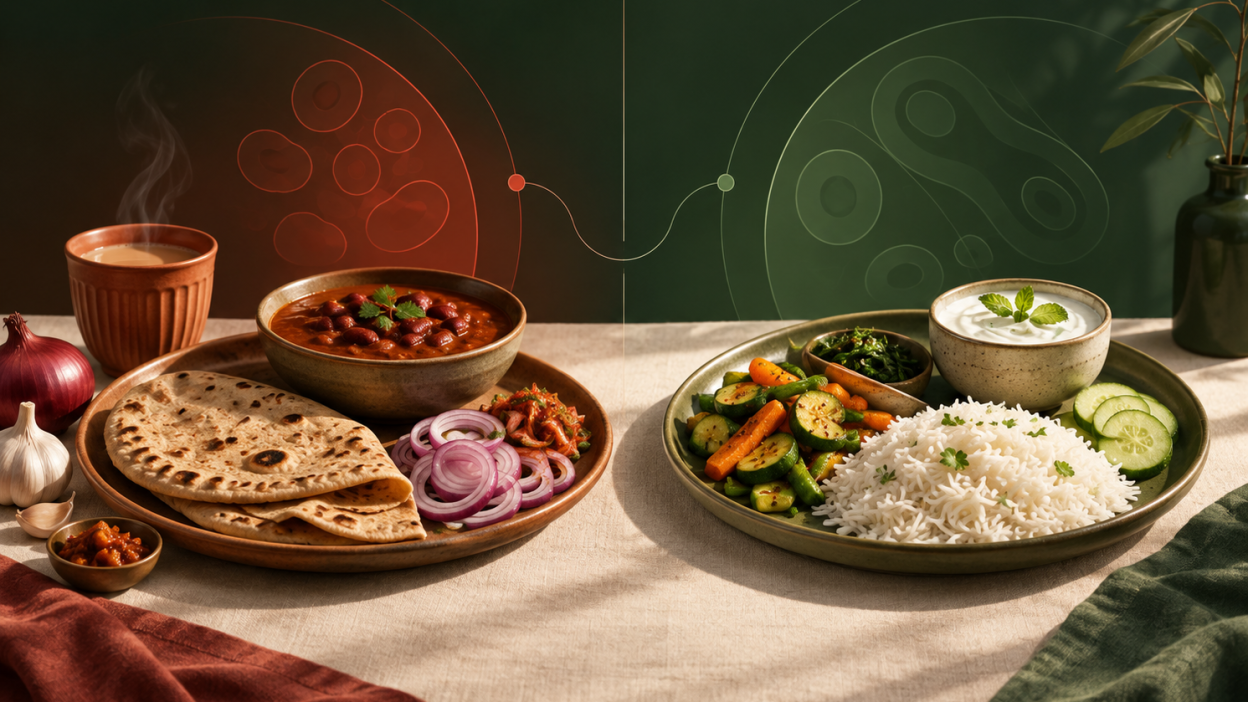
Lunch is roti, dal, and a sabzi that started with onion and garlic. Chai after. That plate carries fructans from the wheat, more fructans from the onion and garlic, GOS from the pulse, and lactose from the milk.
Three hours later you are bloated. Which food did it?
That meal cannot tell you. Maybe one ingredient matters. Maybe several do. Maybe every food would have been fine on its own and the total was the problem.
Which is why “I ate rajma and felt terrible” is an interesting observation, while “rajma is bad for my gut and I can never eat it again” is a conclusion the observation has not earned.
India complicates this further, because there is no single Indian diet to work from. The 2023 Indian consensus statements on IBS, led by Uday Ghoshal and colleagues, point directly at this: wheat versus rice intake, vegetarianism, lactose malabsorption and milk consumption all vary enormously across the country, and India-specific FODMAP studies remain scarce.
Lactose is the clearest example. Babu and colleagues found lactose malabsorption to be both more frequent and more pronounced in healthy southern Indians than in healthy northern Indians.
A vegetarian who lives on dal has a different nutritional risk from restriction than someone who eats little of it. Someone eating rotis three times a day starts somewhere different from someone whose staple is rice.
So the practical instruction is to swap before you subtract. You need enough change to run a readable experiment. You do not need to remove every food that has ever appeared on a high-FODMAP list.
Does it actually work?
Better than the alternatives, and less dramatically than the internet suggests.
Melanie Cuffe, Heidi Staudacher and colleagues pooled 28 randomised trials covering 2,338 patients in a network meta-analysis published in The Lancet Gastroenterology and Hepatology in 2025. For global IBS symptoms, a low-FODMAP diet came fourth of the diets compared, with a relative risk of symptoms not improving of 0.51. For bloating and distension it was the only dietary intervention that beat a habitual diet, across 23 trials. For bowel habit, no diet beat its control, though low FODMAP did outperform standard BDA and NICE dietary advice.
Two honest readings of that. First, the low-FODMAP diet carries more evidence behind it than any other diet for IBS, which is why both the American College of Gastroenterology and the American Gastroenterological Association recommend trying it. Second, the confidence ratings across most of that network were low or very low, and roughly half of people who try it will not respond.
That second half matters more than it usually gets credit for. A diet that helps half of people is worth trying and not worth suffering through indefinitely, which is precisely why the protocol is built with a stopping rule.
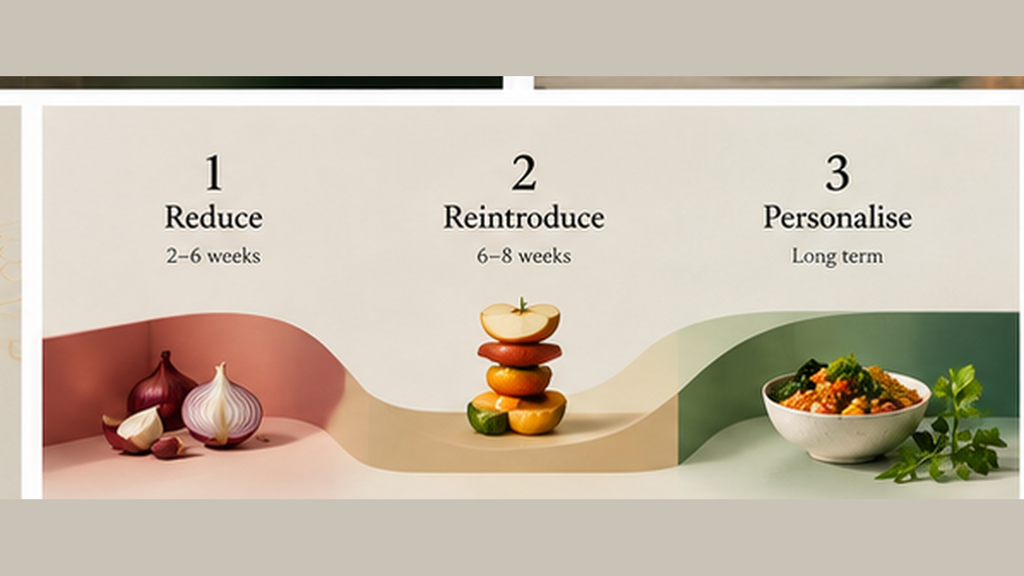
The three stages
Stage 1: reduce the load and see if anything changes
This phase is short by design. The AGA clinical practice update from William Chey and colleagues (Gastroenterology, 2022) puts a hard ceiling on it: restriction lasting no more than four to six weeks. The same update notes that people who respond usually notice improvement within two to six weeks, and that if nothing has shifted by then, FODMAP restriction should be stopped rather than tightened.
The question is not whether you can follow the diet perfectly. It is whether your symptoms meaningfully improve when your FODMAP intake falls.
Pick the symptoms that actually matter to you before you start. If your evenings are ruined by bloating, track bloating. If the real problem is urgency, track urgency. You do not need a spreadsheet of every sensation you have ever had, only enough consistency to tell whether the thing you changed is doing anything.
And if nothing changes after a proper trial, stop. The finding that FODMAP restriction is not an important lever for you is a real result, and it can save you months of pointless food avoidance.
Stage 2: deliberately bring foods back
If Stage 1 worked, you have answered exactly one question. Reducing FODMAPs helped. You still have no idea which ones mattered.
Reintroduction keeps the rest of the diet reasonably stable while you challenge one FODMAP at a time, usually in increasing amounts across about three days, watching what happens.
Spend four weeks feeling better, then celebrate with roti, rajma and milk in a single sitting, and by evening you have tested fructans, GOS and lactose simultaneously and learned nothing.
Karen Van den Houte and colleagues ran a blinded reintroduction phase in IBS patients who had responded to restriction (Gastroenterology, 2024) and found trigger patterns that were highly individual.
If your day contains several wheat-based meals, knowing your fructan tolerance is worth more to you than almost anything else. If you are vegetarian, establishing real GOS tolerance may protect a major source of protein you would otherwise abandon on suspicion.
If something flares during a challenge, the test has produced information. A reaction does not necessarily mean you cannot eat something. It often means you cannot comfortably eat that much of it, or not alongside three other fermentable foods.
Stage 3: build your ordinary diet back
This is where a successful low-FODMAP diet should stop looking like a low-FODMAP diet.
Foods you tolerated return at normal quantities. Foods you tolerated in smaller amounts stay at those amounts. A small number of foods that reliably cause significant symptoms may stay limited.
The output looks something like: milk was fine, so it is back; a smaller portion of dal works, so that is the portion; large wheat-heavy meals are harder than one roti; onion causes trouble at the quantity normally used at home.
Compare that with wheat, milk, onion, garlic, dal and fruit all banned. The second version has more rules. The first has more knowledge, and it is the one you can still eat at someone else’s dinner table.
Is low FODMAP dairy-free?
No. The FODMAP in dairy is lactose, and different dairy foods contain very different amounts of it.
Here the gap between physiology and experience gets interesting. Dinesh Gupta, Uday Ghoshal and colleagues tested 124 north Indian IBS patients and 53 healthy controls. Lactose malabsorption was common in both groups and not statistically different between them: 72% of IBS patients against 60% of healthy subjects. Peak breath hydrogen was comparable too. What differed was that the IBS patients reported symptoms after lactose more often, despite producing the same gas.
Jie Wu and colleagues found the same split more broadly. FODMAPs produced similar small bowel water and colonic gas in IBS patients and healthy controls. The symptoms did not match the physiology.
Which is worth holding onto for the whole process. What is happening inside your gut and what you feel are related, but they are not the same measurement, and the one that matters for your dinner is the second one.
The point is not to eat low FODMAP forever
Restriction is where the process starts because restriction makes the experiment readable. It is not the achievement.
Suppose you come out the other side knowing that lactose is fine, one serving of dal is fine, wheat in smaller amounts is fine, and only a couple of foods or combinations reliably cause trouble. You now have four facts you can use at any meal for the rest of your life: this matters, this does not, this much is fine, this much is not.
FAQs
How do you get rid of IBS in one day?
You cannot, though you can usually shorten a bad day. During a flare – smaller, plainer, lower-fat meals for a few days, keeping fluids up, and using whatever your doctor has already prescribed for that particular symptom. What tends to prolong things is the panic response: cutting four foods at once, starting two new supplements, and losing any ability to tell what helped.
What is the best treatment for IBS?
There is no single best treatment for everyone with IBS.
The useful starting point is identifying what you are trying to improve: pain, bloating, constipation, diarrhoea, urgency or another symptom. Different approaches can improve different parts of IBS without necessarily changing the entire condition.
What foods should I avoid with IBS?
There is no universal list, which is why the ones circulating online are so unhelpful. The groups most often involved are fermentable carbohydrates found in wheat, onion, garlic and pulses, along with lactose, very large or oily meals, and strong coffee on an empty stomach. The same food can be fine on one day and difficult on another, because total load matters as much as any single item. The reliable way to find your own list is a structured low-FODMAP trial with proper reintroduction, not permanent removal on suspicion.
What is a low-FODMAP diet?
A low-FODMAP diet temporarily reduces fermentable carbohydrates that can increase water and gas inside the bowel.
It is normally used in three stages: reduction, reintroduction and personalisation. The aim is to identify which FODMAPs actually cause symptoms and eventually return as much variety to the diet as possible.
Is a low-FODMAP diet the same as a gluten-free diet?
No.
Wheat is relevant to a low-FODMAP diet largely because it contains fructans. Gluten is a protein.
Someone can therefore find that wheat triggers symptoms during a FODMAP experiment without that automatically meaning they have coeliac disease or that gluten itself is responsible.
Can rajma, dal or chana trigger IBS?
They can trigger symptoms in some people because many pulses and legumes contain GOS, a type of FODMAP.
That does not mean everyone with IBS should avoid pulses. Portion size, the type eaten, the rest of the meal and individual tolerance all matter. This is especially important for vegetarians who rely on pulses as a major source of protein.
Why can I eat something one day and react to it the next?
IBS tolerance is not always a simple yes-or-no property of a food.
The amount can matter. Several fermentable foods can add up across the same meal. Your bowel may also be more sensitive during a flare than during a settled period.
One bad reaction is therefore less informative than a pattern that can be reproduced.
Is SIBO the same as IBS?
No.
They can produce similar symptoms and can coexist, but they are different conditions. SIBO may contribute to symptoms in a subset of people with IBS, but current evidence does not support treating it as the universal cause of IBS.
Breath-test results also need careful interpretation because different tests can produce very different answers.
Do probiotics help IBS?
Not reliably, on the evidence available. American guidelines suggest against probiotics for overall IBS symptoms. The 2023 Indian consensus is more open, saying they may be helpful but that more studies are needed, and that statement drew the lowest agreement of any in the entire document. The core problem is that trials use different organisms, doses and outcome measures, so a benefit shown for one specific strain tells you nothing about a different product on a pharmacy shelf. If you do try one, give it a defined period, change nothing else at the same time, and stop if nothing shifts.
Does stress make IBS worse?
Stress can change how loud the symptoms are. Stress affects how the bowel moves and how pain signals are processed, and unpredictable gut symptoms generate their own anxiety in return, particularly the anticipatory kind where the worry is about where the toilets will be rather than about the pain itself. Someone who has cancelled two trips because of their gut has a reasonable fear, not a psychological disorder. Saying stress is a trigger is accurate. Saying stress is the cause is not.
How do I know whether something is actually helping my IBS?
Decide what you want to improve before making the change.
Where possible, avoid starting several interventions at once. Then judge the thing you actually changed against the symptom you were trying to change.
An intervention does not have to improve every IBS symptom to be useful.
Can IBS be cured permanently?
No. IBS is managed rather than cured, and no diet, supplement or medicine currently available removes it for good. What is realistic is long stretches where symptoms are mild or absent, reached by stacking several modest improvements rather than finding one decisive fix. Flares returning after a stressful month, a course of antibiotics or a bad meal is the normal shape of the condition rather than proof that treatment failed.