

People ask for a shortlist. The top five gut health foods. The best foods good for gut health. The one breakfast that fixes digestion. The impulse is understandable, but it leads to bad thinking.
The gut responds less like a judge handing out medals and more like an ecosystem responding to available resources. Different fibres favour different taxa. Different food matrices arrive with different combinations of starches, polyphenols, fats, micronutrients, and physical structures. Dietary patterns and the multidimensional aspects of foods together capture diet-microbiome-health relationships more accurately than narrow nutrient thinking.
In other words, the question is not whether one food is excellent. It is whether the weekly pattern has enough range to support a broader microbial repertoire. That is why the best gut-friendly foods are usually ordinary foods eaten repeatedly and in variation. Taken together, they create a better-fed microbial system.
This guide organises foods into two clear sections: foods that support gut health and foods that drive gut inflammation. Every entry tells you what is in the food and what it actually does in your gut – not what marketing claims it does.
Foods That Support Gut Health
Grains, Legumes, and Resistant Starches
These foods act as premium fuel for beneficial bacteria, particularly through resistant starches and soluble fibres.
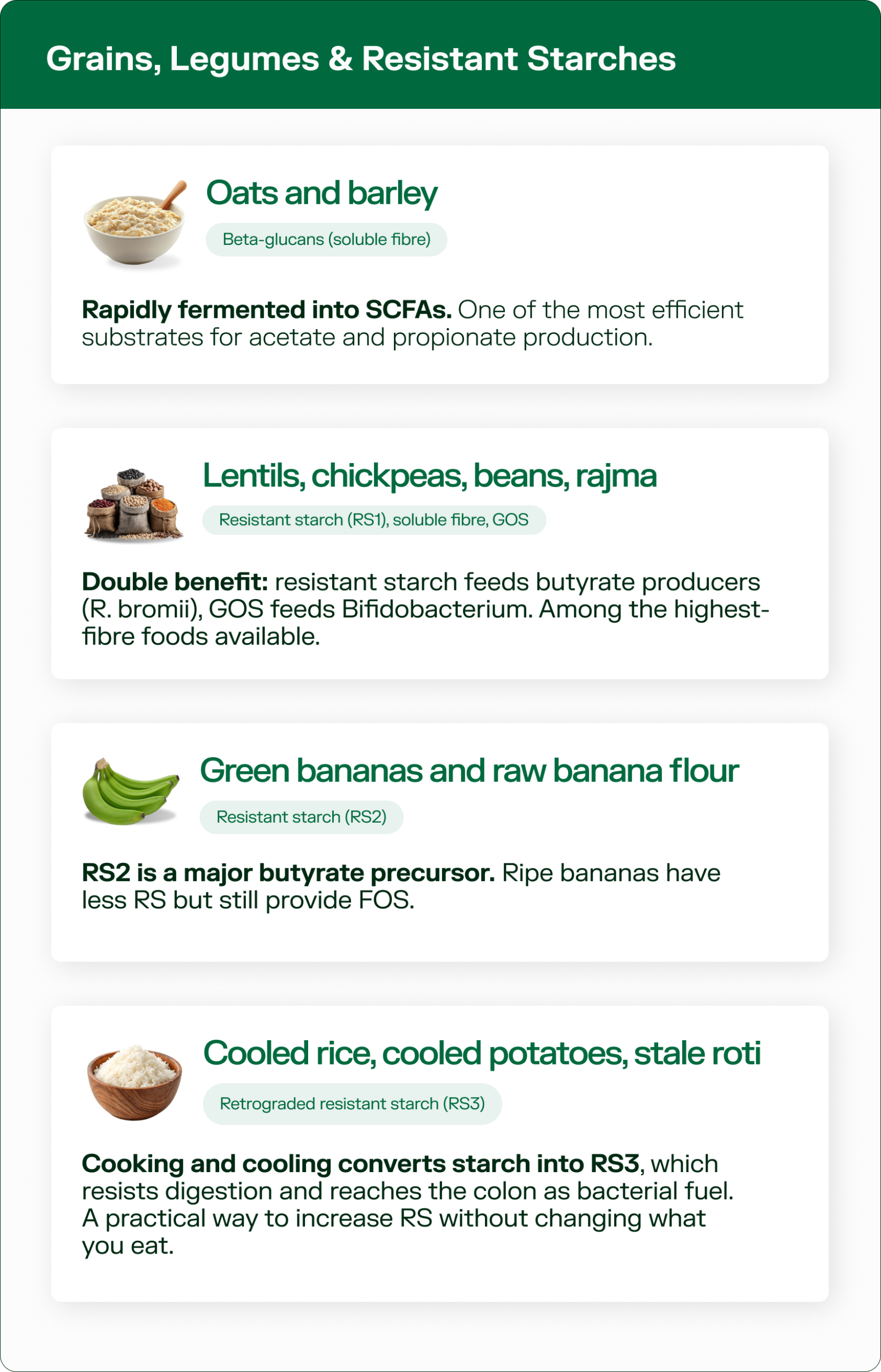
Vegetables and Fungi
Rich in prebiotics, complex carbohydrates, and unique compounds that reduce oxidative stress in the gut.
Fruits
Fruits provide distinct polyphenols, enzymes, and fibres that support barrier strength and microbial diversity.
Fermented Foods (Probiotic Foods)
These naturally introduce live beneficial bacteria and yeasts directly into the microbiome. Fermented foods for gut health have earned their place in the conversation – they introduce beneficial species, and a high-fermented-food diet has been shown to increase microbial diversity and reduce inflammatory markers. But they have not earned the mythology that often trails behind them. They sit best within a broader structure that already has enough fibre and plant diversity.
Nuts, Seeds, and Healthy Fats
Healthy fats and seed fibres lower inflammation and support the structural integrity of the gut lining.
Animal Proteins and Broths
Focused on resolving inflammation and providing direct building blocks for the intestinal barrier.
Spices, Herbs, Beverages, and Chocolate
Potent modulators that improve gut motility, reduce inflammation, and offer protective antioxidants.
Foods That Drive Gut Inflammation
The worst foods for gut health are rarely single villains. They are patterns – chronic, repeated exposures that erode the conditions the microbiome needs to function. What follows are the categories where the evidence is clearest.
Sugars, Sweeteners, and Refined Carbohydrates
These foods strip away necessary fibres, spike glucose, and can alter microbial balance or feed opportunistic bacteria.
Ultra-Processed Foods and Additives
These contain industrial chemicals that directly attack the gut’s protective mucus layer.
Problematic Fats and Frying
Industrial fats and the byproducts of deep-frying introduce systemic inflammation and toxicity to the gut lining.
Heavy Meats and High Saturated Fats
In excess, these promote bile acid overproduction and the generation of inflammatory or carcinogenic metabolites.
Alcohol and Environmental Contaminants
External toxins that increase intestinal permeability and disrupt the natural microbiome over time.
The Macros, Properly Framed: Fibre, Carbs, and Protein
The food tables above tell you what to eat and what to avoid. But to make real sense of those choices, you need to understand how the three macronutrient categories interact with the gut – because each one plays a different role in the ecology, and the balance between them matters more than any of them in isolation.
Fibre: The Thread That Runs Through Everything Above
If you look across the supportive foods listed above – the legumes, the vegetables, the fruits, the nuts, the whole grains – the common denominator is dietary fibre. Fibre is the part of plant food that human enzymes cannot fully break down. It reaches the colon largely intact, where it becomes the primary fuel for beneficial gut bacteria. When those bacteria ferment fibre, they produce short-chain fatty acids – acetate, propionate, and butyrate – which are fundamental to barrier integrity, immune regulation, and metabolic signalling throughout the body.
When fibre intake stays chronically low, microbial diversity drops, SCFA production falls, and the gut ecology shifts towards less favourable metabolic pathways – including degradation of the protective mucus layer itself. This is the mechanism that connects nearly every “bad” food in the inflammatory list: they displace fibre. That is their deepest damage.
We have covered fibre in much greater depth – how different fibre types favour different taxa, why diversity of fibre sources matters, and what happens at the generational level when fibre is absent – in our companion piece: What Is Gut Health and How to Naturally Improve It Through Diet. If you have not read that, it is the fuller picture behind every recommendation in this guide.
Carbohydrates: Context, Not Category
Carbohydrates are the most misunderstood macronutrient in the gut conversation. They are routinely demonised as a category, when the real issue is type and context.
Complex carbohydrates – whole grains, legumes, starchy vegetables, fruits – arrive in the gut with their fibre matrix intact. They are digested more slowly, produce a gentler glycaemic response, and deliver microbiota-accessible carbohydrates (MACs) to the colon. These are the substrates that feed saccharolytic fermentation and support SCFA production. In practical terms, a bowl of dal-chawal with sabzi is delivering resistant starch, soluble fibre, and prebiotic compounds simultaneously – the gut reads that very differently from a plate of maida-based naan with no vegetable component.
Refined carbohydrates – white bread, maida, pastries, sugary drinks – are the opposite. They have been stripped of their fibre matrix, offer almost no MACs, produce rapid glucose spikes, and leave the colonic microbiome with nothing to work with. As covered in the inflammatory foods section above, when bacteria are starved of dietary fibre, they begin to forage on the mucus layer instead, thinning the barrier between gut contents and the bloodstream.
The problem was never carbohydrates as a category. It was always the processing that strips them of what the gut actually needs.
Protein: Not the Problem, but Not the Solution Either
Protein deserves more nuance than the gut conversation usually gives it.
A useful protein intake supports muscle mass, satiety, recovery, and metabolic health. For many people – especially those who travel often, train regularly, struggle with appetite, or need convenience – protein shakes can make practical sense. Demonising them would be lazy. The problem is not protein. The problem is the nutritional imagination that assumes a good protein intake equals a good diet.
When dietary pattern shifts towards high protein and very low fermentable carbohydrate, the microbial consequences change. Research has reproducibly shown that a high-protein, low-carbohydrate diet significantly reduces total short-chain fatty acid and butyrate production, while increasing metabolites derived from amino acid fermentation – including branched-chain fatty acids, ammonia, and N-nitroso compounds with potentially harmful properties.
The point is not that protein is dangerous by default. It is that a low-fibre pattern pushes fermentation towards less favourable substrates. A high-fibre diet, by contrast, helps keep saccharolytic fermentation dominant and can counter many of the detrimental effects associated with heavy meat and fat intake.
That is the angle most public writing misses. Protein shakes are not bad. They are simply too small to solve a system problem. A scoop can help you hit a number. It cannot supply the fibre diversity, food complexity, and microbial substrate that a thin overall pattern lacks.
How to Think About This List
The goal is not to eat everything on the supportive list and avoid everything on the inflammatory list. The goal is pattern. More of the former, less of the latter, repeated consistently across weeks and months. The gut does not respond to individual meals with the drama that marketing suggests. It responds to the accumulated signal of what you feed it over time.
Digestion often deteriorates not because the body lacks one magic item, but because the diet has become monotonous, overprocessed, or chronically low in the fibres and food structures that keep the gut working with some rhythm. The three macro sections above tell you why. The food tables tell you how.
Frequently Asked Questions: What to Eat and What to Avoid for a Stronger Gut Microbiome
Good gut bacteria foods are usually fibre-rich and varied: beans, lentils, oats, onions, garlic, leeks, bananas, apples, berries, nuts, seeds, and fermented foods with live cultures. The goal is to create conditions in which different beneficial microbes have enough to work with – not to find a single superfood.
The clearest problem pattern is a diet dominated by ultra-processed, low-fibre foods that displaces more supportive foods. Emulsifiers (CMC, P80) found in most packaged foods have been shown to thin the mucus layer in animal models. Excess refined sugar, trans fats, and regular heavy alcohol consumption also damage barrier integrity. But the smarter question is not “what single food is bad?” – it is “what pattern keeps starving the system?”
People search for gut healing foods because it is an appealing idea. Science points to something less romantic and more useful. The gut generally responds to dietary pattern, not miracle foods. Certain foods can support barrier function, microbial diversity, and anti-inflammatory metabolite production – but the effect comes from repeated context, not magic.
The most commonly available natural probiotic foods include fermented yoghurt, kefir, kimchi, sauerkraut, miso, tempeh, and traditional Indian fermented foods such as idli, dosa, chaas, and kanji. They introduce live bacterial cultures directly. The key is choosing products with live cultures – pasteurised or heat-treated versions lose this benefit.
For most healthy people, regularly consuming fermented foods is a more ecologically coherent approach than supplementation. Fermented foods provide live cultures alongside fibre, nutrients, and organic acids from the food matrix itself. Most commercial probiotic supplement strains do not permanently colonise the gut, and their efficacy is strain-specific. Supplements may have value in specific clinical contexts such as post-antibiotic recovery.
Traditional Indian cuisine is rich in gut-supportive foods: dal and rajma (resistant starch, soluble fibre), chaas and lassi (probiotic cultures), fermented batters for idli and dosa (Lactobacillus, Leuconostoc), turmeric (colonic anti-inflammatory), ajwain and cumin (carminatives supporting motility), and ghee (a direct dietary source of butyric acid). The traditional thali structure – diverse plant foods, fermented elements, and spices – naturally supports microbial diversity.
Diet is the single most repeated input the gut microbiome receives, and it is the most evidence-supported lever for improving gut health naturally. Increasing fibre diversity, eating fermented foods, and reducing ultra-processed food intake are the foundations. Exercise, sleep, and stress management also play roles. For persistent or severe symptoms, consult a clinician – diet alone may not address underlying conditions.