


Intermittent fasting is one of the most searched eating patterns in the world, and the research behind it has grown with interest. Human studies support a few potential benefits of intermittent fasting. It can help some people lose weight, may improve insulin sensitivity and blood sugar control, and can improve some cardiovascular risk markers. For some people, restricting when they eat is also easier than counting calories every day. Brain and longevity benefits are also being studied, but most of that evidence still comes from animal research.
So what actually happens when you fast? And does intermittent fasting work better than simply eating less? This article covers how intermittent fasting works, what the evidence supports, what it doesn’t, and who should be careful before trying it.
In short: Intermittent fasting can help some people lose weight and may improve insulin sensitivity, blood sugar control and some cardiovascular risk markers. Most research suggests it is not dramatically better than standard calorie restriction for weight loss. Claims about autophagy, brain health and longer lifespan are much less certain in humans.
What Is Intermittent Fasting?
Intermittent fasting means cycling between periods of eating and periods without food. Unlike most diets, it does not necessarily tell you what to eat. It mainly changes when you eat.
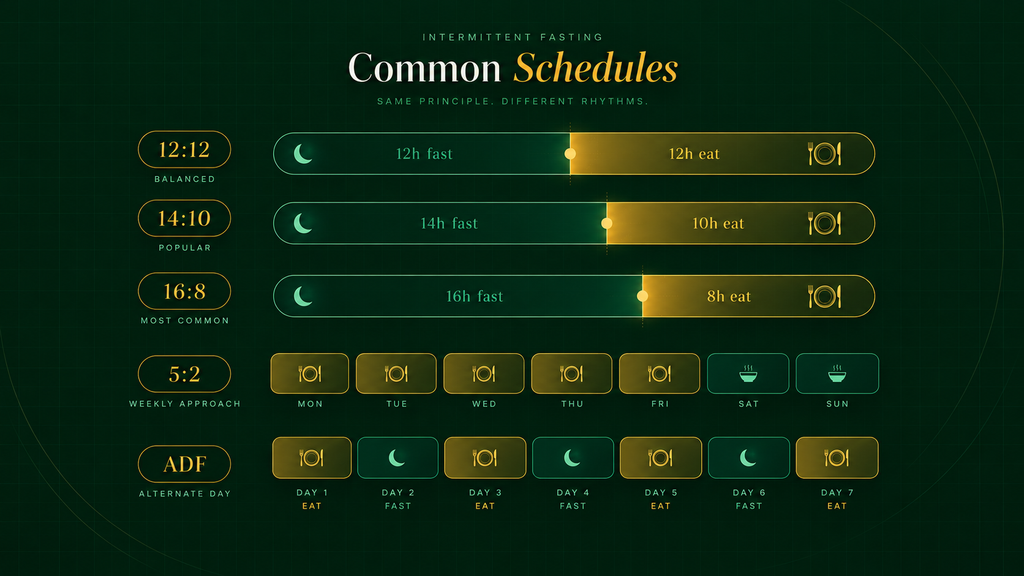
| Fasting pattern | What it usually looks like |
| 12:12 | Fast for 12 hours and eat within a 12-hour window |
| 14:10 | Fast for 14 hours and eat within a 10-hour window |
| 16:8 | Fast for 16 hours and eat within an 8-hour window |
| 5:2 | Eat normally on five days of the week and substantially reduce calories on two days |
| Alternate-day fasting | Alternate between normal eating days and fasting or very-low-calorie days |
These approaches are often grouped together under “intermittent fasting”, but they are not biologically identical and have not been studied equally.
Food quality also still matters. An eight-hour eating window does not cancel out a diet that is consistently low in protein, fibre and micronutrients or high in excess calories.
How Intermittent Fasting Works
When you eat, glucose from food becomes an important source of energy. Insulin rises, helping move glucose into cells and supporting the storage of excess energy.
As time passes after a meal, insulin levels fall and the body begins drawing more heavily on stored energy.
The metabolic switch
One process researchers study is metabolic switching.
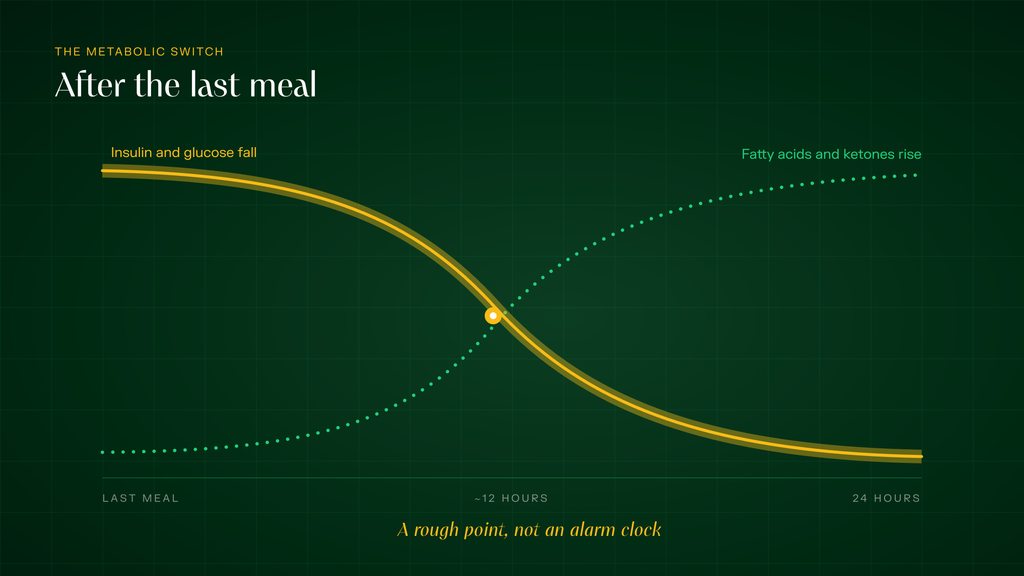
As readily available glucose and liver glycogen fall, the body gradually increases its use of fatty acids and ketone bodies for energy.
You will sometimes see claims that this switch happens precisely at the 12-hour mark. Human biology is not that exact.
The timing depends on factors such as what you ate before the fast, how much glycogen you have stored, physical activity and your individual metabolism. Around 12 hours is better thought of as a rough point at which this transition may begin, not a biological alarm clock.
Researchers including Mark Mattson and Rafael de Cabo have proposed that regularly moving between fed and fasted states may affect metabolic regulation and cellular stress responses. Much of the detailed mechanistic evidence, however, still comes from animal studies.
Insulin falls between meals
The insulin effect is more straightforward.
Eating, particularly carbohydrate-containing meals, stimulates insulin secretion. During fasting, circulating insulin generally falls.
That creates a longer period each day in which the body is not responding to a recent influx of food. In some people, particularly those with insulin resistance, this pattern may contribute to improvements in insulin sensitivity.
But lower insulin during a fast does not automatically mean that someone has “reversed insulin resistance”. The longer-term effect depends on overall diet, body composition, activity, sleep, weight change and existing metabolic health.
What about autophagy?
Autophagy is the process through which cells break down and recycle damaged or unnecessary components.
It is real biology. Yoshinori Ohsumi received the 2016 Nobel Prize in Physiology or Medicine for discoveries explaining mechanisms of autophagy.
Where fasting conversations often go too far is the timing.
Fasting can stimulate autophagy in animal models. What we do not yet know is that 14, 16 or 18 hours without food produces a specific, clinically meaningful amount of autophagy in humans.
So “16 hours of fasting switches on cellular repair” is much more certain than the human evidence allows.
Intermittent Fasting for Weight Loss
Weight loss is the most studied benefit of intermittent fasting.
And the overall finding is fairly consistent: intermittent fasting can help people lose weight, but it is usually not dramatically better than conventional calorie restriction.
A 2025 BMJ network meta-analysis looked at 99 randomised clinical trials involving 6,582 adults. Intermittent fasting approaches and continuous calorie restriction both reduced body weight compared with eating without a calorie restriction. Alternate-day fasting showed a small additional weight-loss advantage over continuous calorie restriction, but the difference was modest.
Earlier long-term trials have reached a similar conclusion.
Why, then, does intermittent fasting work for some people?
Often because it simplifies eating.
If you normally have breakfast at 8 am, chai and biscuits at 11 am, lunch at 1 pm, another snack at 5 pm and dinner at 9:30 pm, shortening the eating window removes some opportunities to eat.
You may consume fewer calories without having to count every one.
That can make intermittent fasting easier for some people to follow than a diet built around constant calorie tracking.
But the reverse can happen too. If a 16-hour fast leaves you so hungry that you compensate with much larger meals during the eating window, the calorie deficit may disappear.
Does intermittent fasting reduce belly fat?
It can reduce waist circumference and visceral fat as part of overall fat and weight loss. It cannot selectively tell the body to burn abdominal fat first.
Studies comparing intermittent fasting with continuous calorie restriction generally find broadly similar reductions in weight and body fat over time. Longer-term evidence also suggests the two approaches produce fairly comparable cardiometabolic results.
So intermittent fasting for belly fat is better understood as one possible way to reduce overall energy intake and body fat, not a targeted abdominal-fat treatment.
There is another consideration: muscle.
Weight loss can include both fat and lean tissue. One 2020 randomised trial of a 16:8-style eating window raised concerns about loss of lean mass in a subgroup of participants. It does not prove that intermittent fasting inherently causes muscle loss, but it is a reminder that protein intake and resistance training still matter when losing weight.
Intermittent Fasting, Insulin and Blood Sugar
The metabolic effects of fasting are one of the more interesting areas of research.
A small but important 2018 trial studied men with prediabetes using early time-restricted eating, where food was eaten within a six-hour window and dinner finished in the afternoon.
After five weeks, insulin sensitivity and blood pressure improved even without weight loss. That suggests meal timing may sometimes affect metabolism independently of simply losing weight.
But results across studies are not uniform.
A 2024 meta-analysis involving adults with prediabetes or type 2 diabetes found reductions in body weight, HbA1c and fasting glucose compared with control diets. Other analyses comparing intermittent fasting directly with conventional calorie restriction find much smaller differences between the two approaches.
The reasonable conclusion is not that intermittent fasting “reverses diabetes”.
It is that it can be one dietary strategy for improving weight and glycaemic control in some people.
That distinction becomes particularly important if you take insulin or glucose-lowering medication. Changing meal timing without adjusting medication can cause hypoglycaemia, so fasting in this situation should be planned with a doctor.
Is Intermittent Fasting Good for Heart Health?
Possibly, but this is another area where risk factors and actual disease outcomes need to be separated.
Studies of intermittent fasting have reported changes in:
- blood pressure,
- triglycerides,
- LDL cholesterol,
- fasting glucose,
- insulin resistance,
- and body weight.
Recent systematic reviews suggest some of these markers can improve, particularly in people with overweight, obesity or metabolic dysfunction. But the effects are not consistent across every study, and intermittent fasting is often no better than conventional calorie restriction when the two are compared directly.
More importantly, improving a risk marker is not the same as proving that intermittent fasting prevents heart attacks or cardiovascular disease.
We do not currently have the kind of long-term human trials needed to make that claim.
So if the question is, “Is intermittent fasting good for heart health?”, the answer is more specific:
It may improve some cardiovascular risk factors in some people. We do not yet know whether intermittent fasting itself reduces cardiovascular events over the long term.
What About Inflammation?
You will also see intermittent fasting described as an “anti-inflammatory” diet.
There is some evidence behind this, but it is not as consistent as the term suggests. Some fasting studies report reductions in inflammatory markers such as CRP or IL-6, particularly in people with metabolic dysfunction. Other studies find little difference.
Weight loss itself can also reduce inflammation, which makes it difficult to separate the effect of fasting from the effect of losing body fat.
At this point, reduced inflammation is better treated as a possible metabolic effect in certain groups, rather than a guaranteed benefit of fasting.
Intermittent Fasting, Brain Health and Longevity
Animal studies have linked intermittent fasting and calorie restriction with changes in pathways involved in:
- cellular stress resistance,
- insulin signalling,
- neuroplasticity and,
- lifespan.
Studies in rodents have also reported changes in brain-derived neurotrophic factor, or BDNF, which plays a role in learning, memory and neuronal health.
These findings are scientifically interesting.
They are not the same as showing that intermittent fasting prevents Alzheimer’s disease, makes people cognitively sharper or helps humans live longer.
Human trials on fasting and cognition remain relatively small and short. And we do not currently have robust evidence that intermittent fasting extends human lifespan. Fasting affects biological pathways that are also involved in ageing. That gives researchers a reason to study it.
It does not yet give us a reason to promise longevity.
Is 16:8 Intermittent Fasting the Best Schedule?
16:8 is probably the best-known intermittent fasting schedule because it is relatively easy to understand.
You eat within eight hours and fast for sixteen.
That might mean:
10 am to 6 pm,
11 am to 7 pm, or
12 pm to 8 pm.
But these schedules may not produce exactly the same metabolic response.
Human metabolism follows a circadian rhythm. Insulin sensitivity and the body’s ability to handle glucose tend to be better earlier in the day than late at night.
This is one reason researchers have become interested in early time-restricted eating.
A 2022 randomised trial in adults with obesity compared an early eight-hour eating window, 7 am to 3 pm, with eating across 12 or more hours. Both groups were also following a weight-loss programme. The earlier eating group lost about 2.3 kg more over 14 weeks, although the effect on body fat was less clear.
That does not mean everyone should stop dinner at 3 pm.
Work, family meals, commuting and social life matter. An eating schedule you cannot maintain is unlikely to help much.
For someone starting out, 14:10 may be easier than jumping immediately to 16:8. Simply finishing dinner a little earlier and removing late-night snacking can create a meaningful overnight fasting period without dramatically restructuring the day.
There is no single intermittent fasting plan that has been proven best for everyone.
Who Should Be Careful With Intermittent Fasting?
Intermittent fasting is not a universal health recommendation.
| Situation | Why fasting needs more caution |
| Pregnancy or breastfeeding | Energy and nutrient requirements are higher |
| Diabetes treated with insulin or some glucose-lowering medicines | Changing meal timing can cause hypoglycaemia |
| Current or previous eating disorder | Restrictive eating windows may trigger harmful behaviours or relapse |
| Underweight people | Further reduction in energy intake may be inappropriate |
| Children and adolescents | Growth increases energy and nutrient requirements |
| Athletes with very high training loads | Restricted eating windows may make fuelling and recovery harder |
| Medication that must be taken with food | Meal timing can interfere with safe medication use |
| Recovery from illness, surgery or significant weight loss | Consistent nutrition may be more important than fasting |
People can also experience hunger, headaches, irritability, fatigue or difficulty concentrating when they first change their eating schedule.
Persistent dizziness, fainting, repeated hypoglycaemia or feeling physically unwell are not signs that you need to “push through” a fast.
Does Intermittent Fasting Really Work?
Yes, for some goals and some people.
It can be a practical way to reduce calorie intake and lose weight. It may improve insulin sensitivity, blood sugar regulation and some cardiovascular risk markers.
But intermittent fasting is not metabolically magical.
For most weight and cardiometabolic outcomes, the evidence suggests it performs broadly similarly to conventional calorie restriction. Its biggest advantage may simply be that some people find it easier to follow.
And adherence matters.
The best eating pattern is not the one with the most impressive mechanism on Instagram. It is one that improves your health, gives you adequate nutrition and fits your life well enough to continue.
Where Intermittent Fasting Fits Into the Bigger Picture
Intermittent fasting is a tool. It is not something everyone needs to do, and a longer fasting window is not automatically healthier. If you choose to try it, start with the reason.
Are you trying to lose weight?
Improve glucose control?
Stop late-night eating?
Create a more regular meal schedule?
Then look at whether the change is actually doing what you wanted it to do.
Body weight is one measure. Depending on the goal, blood glucose, HbA1c, lipids, blood pressure, waist circumference, energy, training performance and how sustainable the eating pattern feels can all add context.
FOXO Primer is FOXO’s first complete measurement and playbook cycle. It combines a detailed health and symptom history with blood and urine markers, then brings that information together into a personalised playbook reviewed by a FOXO Doctor. Primer also includes one playbook call with a FOXO Doctor, with ongoing support through OME and the FOXO app.
The point is not to fast because intermittent fasting is popular. It is to understand what you are trying to improve, choose an approach that fits your life, and measure whether it is actually working.
FAQs
What does intermittent fasting mean?
Intermittent fasting is an eating pattern that alternates between defined periods of eating and fasting. Common approaches include 14:10, 16:8, the 5:2 diet and alternate-day fasting.
Does intermittent fasting work for weight loss?
Yes. Intermittent fasting can help with weight loss, particularly when shortening the eating window reduces overall calorie intake. Most research finds that weight loss is similar to standard calorie restriction rather than dramatically greater.
How long does intermittent fasting take to work?
Changes in hunger, meal timing and glucose patterns can happen quickly. Measurable changes in weight and metabolic markers usually require several weeks or months and depend on the fasting pattern, overall diet and starting health.
Is 16:8 better than 14:10 intermittent fasting?
Not necessarily. There is no strong evidence that 16:8 is universally better. A 14:10 schedule may be easier to sustain, while longer fasting windows have been studied more extensively for some outcomes.
What are the main benefits of intermittent fasting?
The strongest human evidence is for weight management and improvements in some metabolic markers. Possible benefits include better insulin sensitivity, improved glycaemic control and changes in blood pressure or lipids in some groups.
Can intermittent fasting reduce belly fat?
It can reduce abdominal and visceral fat as part of overall fat loss, but fasting does not specifically target belly fat.
Is intermittent fasting good for heart health?
It may improve some cardiovascular risk factors, including body weight, blood pressure, triglycerides and glucose control. It has not yet been proven to prevent heart disease or heart attacks.
Can intermittent fasting help with diabetes?
It may improve glucose control and insulin sensitivity in some people with prediabetes or type 2 diabetes. Anyone using insulin or glucose-lowering medication should speak with their doctor before fasting because medication requirements may change.
Does intermittent fasting cause autophagy?
Fasting activates autophagy in animal models. Autophagy also occurs in humans, but research has not established a precise fasting duration, such as 16 hours, that reliably produces a specific clinically meaningful amount of autophagy.
Is intermittent fasting safe for everyone?
No. It may be inappropriate during pregnancy or breastfeeding, for people with a history of eating disorders, for people who are underweight, and in several medical or medication-related situations.